
Festive lights

Home away from home
‘Tis the season. They travel in darkness, thousands upon thousands of wings beating their way through the sky. Feathered rivers flowing northward. And then they pause. Maybe they’ve reached their final destination or maybe they’re refueling before continuing their journey. But wherever they land, they light up our worlds with their jewel-bright colors and evocative songs.
“Lying in bed this morning and had these two right outside my window!!” exclaimed my Vermont sister via text on May 17th, attaching a screenshot from her Merlin bird app. It showed an Ovenbird, a ground-nesting warbler whose teacher Teacher TEAcher TEACHER resonates through eastern forests in springtime, and a Scarlet Tanager, whose robin-with-a-sore-throat song seems incompatible with this black-winged bird’s crimson beauty.
“My morning coffee serenade!!” my Montana sister proclaimed two days later, sending a Merlin screenshot that listed Yellow Warbler, California Quail, American Goldfinch, MacGillivray’s Warbler, House Finch, Red-winged Blackbird, and Black-headed Grosbeak. “I have 20 Bullock’s Orioles, 2 Western Tanagers, and tens of siskins and goldfinches [in my yard]!” a friend in Wyoming enthused the same day.
Throughout the northern hemisphere, those of us who love birds exclaim to friends and family as brilliant tanagers, orioles, buntings, grosbeaks, and wood-warblers appear as if by magic to brighten our dawns and repopulate our local habitats. Among our most colorful birds, these travelers bring the months-long migration season to a concluding crescendo, putting a festive exclamation point on the season. Their more cryptic counterparts announce their arrival through their songs, and our forests are once again filled with the ethereal flutes of wood thrushes, the varied warbling of wood-warblers, and the insistent calls of vireos and pewees. In a world besieged by a warming climate, habitat destruction, poaching and persecution, introduced predators, and endless obstacles, it seems nothing short of miraculous that so many of “our” birds have made it home.
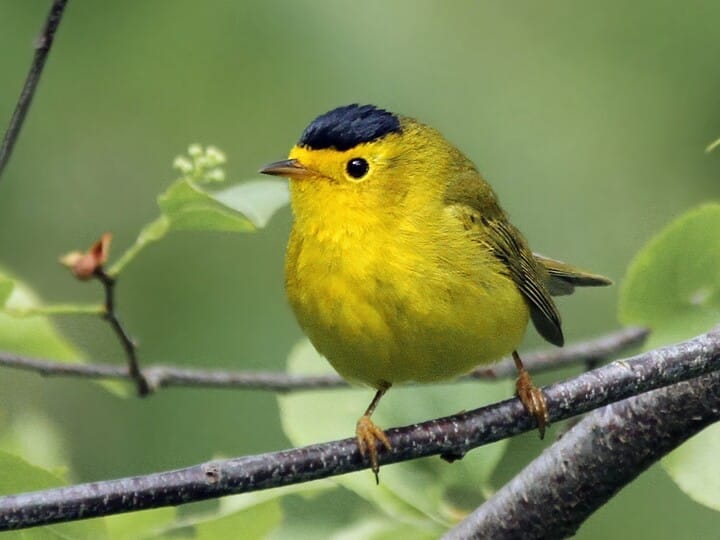
Two decades ago, I visited one of their winter haunts for the first time while working to conserve parrots in Guatemala. I’d spent my first days dazzled by an exotic panoply of tropical birds. And then, amidst the novel glamor, I was confronted by the familiar—a bright yellow bird with a jaunty black cap—a tiny Wilson’s Warbler.
“Oh, it’s one of our birds,” I exclaimed in delight to my Guatemalan colleague.
“Your birds?” Marco asked incredulously, with a wide smile and laughter in his eyes. “These are our birds. Each year, you send them back to us exhausted, nearly emaciated, and in their worn plumage. And each year we care for them, feed them, dress them in their finest plumage, then loan them back to you.” I laughingly conceded his point. Many birds molt into drabber plumages before their southward migration and burn accumulated fat on their long journeys. But Marco’s words forever changed my northern-hemisphere bias.
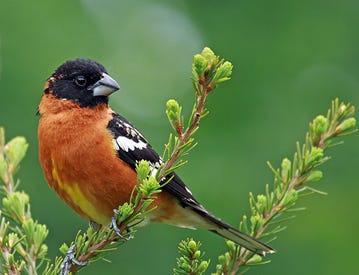
May 26. I glance out my kitchen window and see an unusual flash of color. It’s a Black-headed Grosbeak, a striking orangish bird with checkered black-and-white wings. Facing snow-capped mountains, the grosbeak drinks from my bird bath and avails himself of a few black-oil sunflower seeds. The golden stripe that splits his ochre front flames in the setting sun. He is a festive springtime light, a beloved local bird, a visitor from central Mexico, a beacon we can celebrate—and support—no matter which hemisphere is welcoming him home.
Take a small step to help birds
It is easy to feel helpless in the face of declining bird populations. But according to the US Fish and Wildlife Service, over 96 million people in North America watch birds. If each of us does something to help them, we may be able to reverse their declining numbers and send more of them back to their winter haunts.
Here are a few things you can do:
Artificial night lights exact a heavy toll on a wide variety of wildlife and are particularly perilous for migrating birds. Eliminate or reduce night lighting as much as you can. If such lighting is essential, point lights downward or use motion sensors. Avoid any use of solid red lights. In a relatively recent win for birds, the Federal Aviation Administration changed its requirement for steady-burning red lights on communication towers to blinking red lights. Years of research had shown that migratory birds were drawn to non-flashing tower lights and died in the millions from confusion, exhaustion, and collisions with communication towers and their supporting guy wires.
Create a safe environment for weary avian travelers. Corral wayward felines and place decals on your windows. If you have bird feeders, placing them as far away as possible from picture windows can help reduce collisions if songbirds launch into panicked flight when an avian predator swoops through your yard.
The essentials for “stopover” habitat during bird migration are food, water, and shelter. If you feed wild birds, consider including a clean water source (like a birdbath) and planting native shrubs. Brush piles can also be great cover for birds and other wild creatures.
Thank you for reading and thanks for all you do to help birds!
Until next time …
P.S. For more information about amazing migrations, like those of Rufous Hummingbirds and Peregrine Falcons, check out my new book Feather Trails—A Journey of Discovery Among Threatened Birds.
The evocative word paintings and sheer joy with which you write about our beloved harbingers of spring (and our stalwart residents) put a smile on my face everytime I read your books, articles, and substack. Thank you thank you, Sophie!
Although I love some of our drab residents, there is a special leap of the heart that happens when the bright jewels arrive 😃!