
Subtle piper

Winter’s accompaniment
For some, winter in the north can be a bleak time, a lonely time. But it’s almost impossible to feel alone when birds fill the frosty air with their songs and calls. Few birds sing in winter, but those that do hold a special spot in the hearts of those who wander in wild places. The captivating American Dipper—denizen of western mountain streams—was naturalist John Muir’s favorite accompaniment during his “lonely wanderings” in California’s Sierra Mountains. The irrepressible Northern Cardinal adds a cheerful note to many a northeasterner’s trudges through snowy landscapes. And the subtly lovely Townsend’s Solitaire punctuates the long walks I take along the rural roads near my Montana home with its clarion, piping call and burbling song.
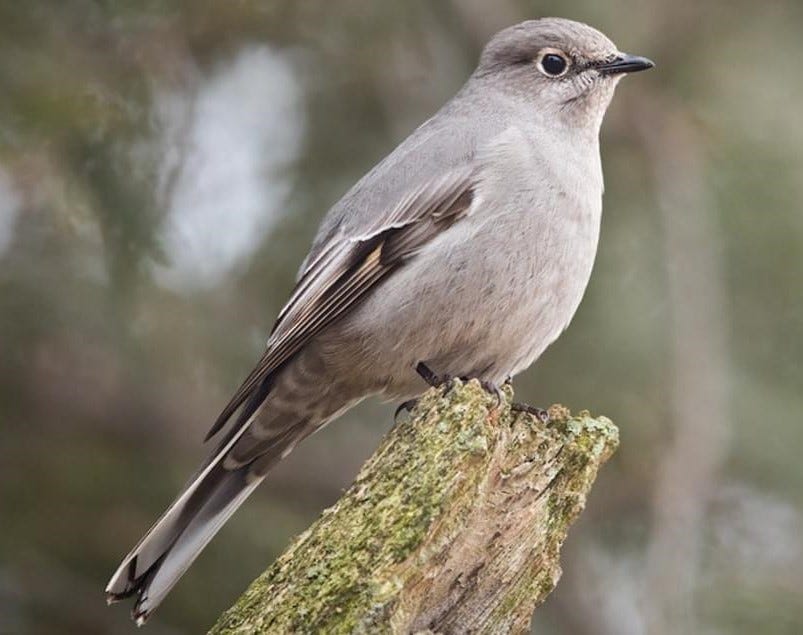
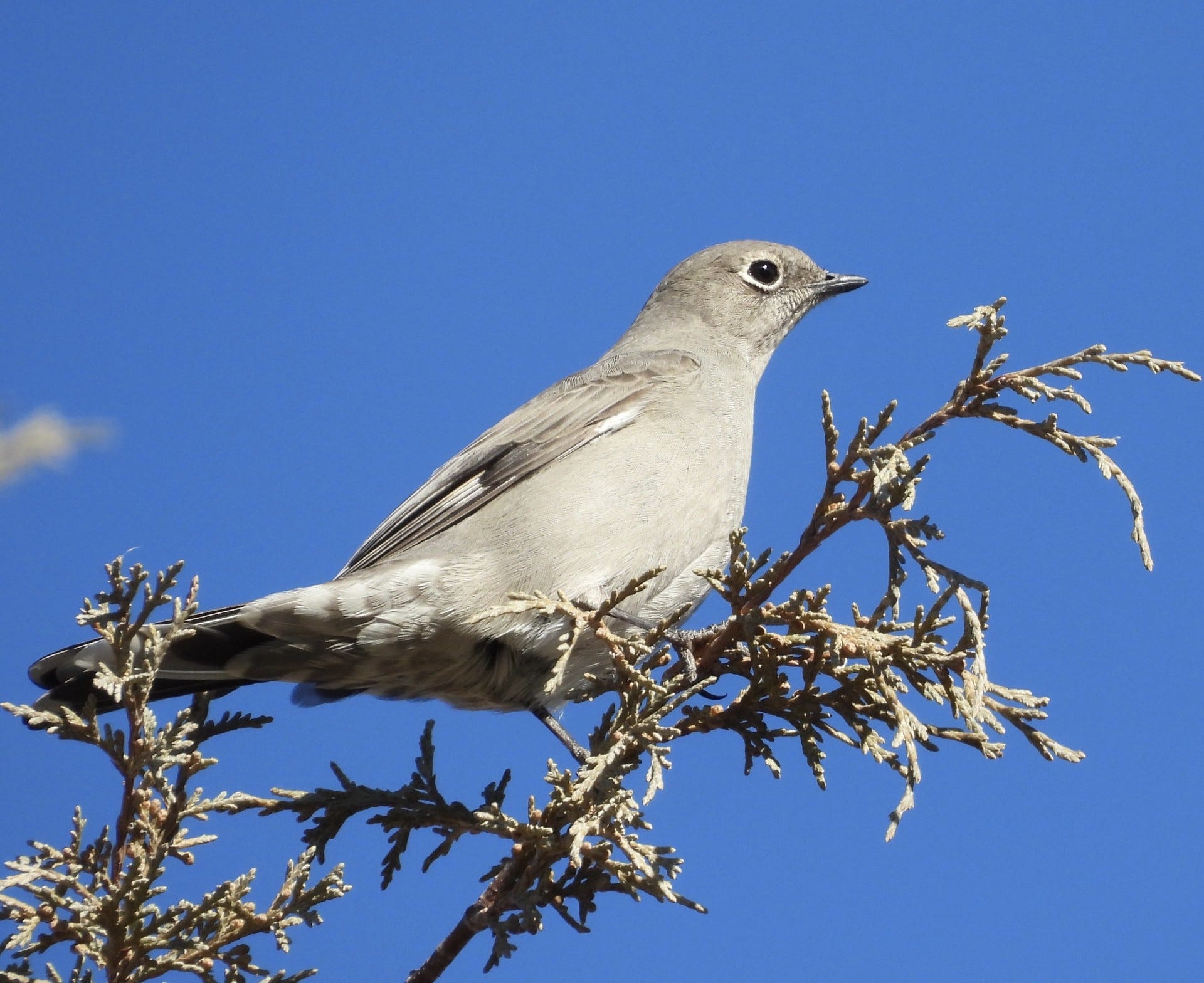
A bird of western-mountain forests, the Townsend’s Solitaire is a slender songbird mid-way in size between the showy bluebirds and red-breasted robins that are its close relatives in the thrush family. Its quiet, grayish plumage is complemented by striking white eye-rings, buffy wing patches, and outer white tail feathers that flash when the bird takes flight.
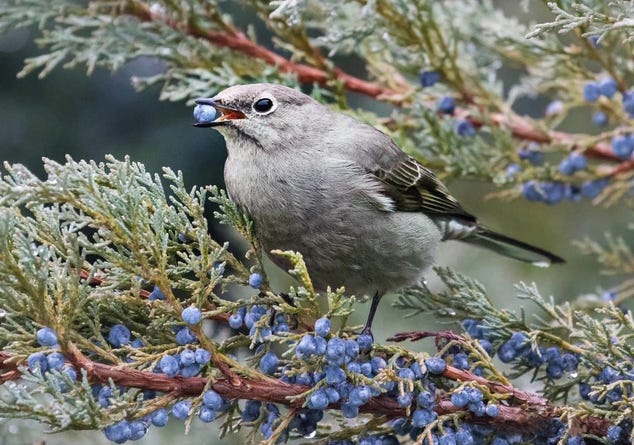
Until recently, I rarely saw Townsend’s Solitaires during the breeding season, when they perch unobtrusively in open pine, fir, or spruce forests, sallying out like flycatchers to catch insects for themselves and their young. But in winter, I regularly walk through a dense concentration of solitaires. While some Townsend’s migrate to warmer areas in winter, others move short distances to lower elevations where juniper trees are abundant. The long, narrow valley bordering the topographical uplift where I live is cloaked in Rocky Mountain junipers and scattered ponderosa pines—ideal habitat for birds that survive winter’s cold and snow by feeding on juniper berries.
Although the solitaires will eat a variety of berries if they are available, junipers are a predominant component of their winter diet and individual birds may consume as many as 200 juniper berries a day. Wintering solitaires vigorously defend berry-rich territories, perching on prominent outposts and proclaiming their ownership with a ringing call and a melodious jumbled song that sounds a bit like an over-caffeinated American Robin.
Last year, a Townsend’s Solitaire began taking advantage of my bird bath—giving me opportunities to relish the subtle loveliness of its muted plumage—and I often heard it calling from the scattered junipers that flank my neighbor’s hill. Its presence never failed to delight me given how rarely I’d spotted solitaires in the past. It seemed to embody an elusive presence that haunts wild woodlands. And it brought to mind, too, its tropical counterparts—like the Black-faced Solitaire and Slate-colored Solitaire—that broadcast ethereal songs through remote montane forests.
So when a flash of nearby movement caught my eye when I was in my kitchen the other day, wild-loving solitaires were far from my thoughts. Moving to my east window, I peered up to the roofline—and into the curious eye of a Townsend’s Solitaire that was stretching down to look at me. There is something special about a wild animal looking into your eyes as you acknowledge each other’s existence—without fear, without fanfare. The solitaire’s bright eye-rings gave the bird a wide-eyed, confiding look. After a moment of calm investigation on both sides of the glass, I backed away slowly, moving out of view so the solitaire could continue its activities without being startled by mine.
The moment was an unexpected winter gift—a reminder that sometimes the wild is just outside our front doors. And sometimes, companionship is just a bird song away.
Take a small step to help birds
Birds are in crisis and need our help more than ever. According to the US Fish and Wildlife Service, over 96 million people in North America watch birds. If each of us does something (anything!) to help them, we may be able to reverse declining bird numbers.
Be like a Townsend’s Solitaire and eat berries! But buy organic ones if you can. Neonicotinoid pesticides, which are widely used in conventional agriculture, are absorbed into a plant’s fruits, so you cannot wash them off. Organic farming is better for birds, better for us, and better for our environment. [Note: juniper “berries” are actually the modified cones of female juniper trees.]
If you have a yard, consider planting a native berry-producing shrub or tree this spring to support berry-loving birds and native insects. Few of our native insects are adapted to feed on introduced, non-native plants. So, a yard containing only these ornamentals will host relatively few insects, which are a critical food source for many nesting birds. I’ve seen this firsthand with the two serviceberry shrubs in my yard. One is a cultivar; the other is a native plant. I’ve learned to delight in seeing the munched leaves of my native serviceberry, knowing it’s fed a host of native insects that are then consumed by my local phoebes, bluebirds, and swallows. In contrast, the leaves of my cultivar serviceberry remain pristine, and the plant provides little ecological value.
If you’re feeding suet to birds this winter, use an upside-down feeder to prevent the suet from being devoured by introduced European Starlings, which outcompete our native birds for scarce nesting cavities. Chickadees, nuthatches, and woodpeckers quickly learn to access the suet this way. Starlings have a harder time feeding upside down.
Until next time …
P.S. If you purchase my book Feather Trails—A Journey of Discovery Among Endangered Birds from Chelsea Green Publishing, you can get 35% off by using the code CGP35 at checkout. If you’ve read and enjoyed the book, please consider giving it a rating on Goodreads or Amazon.
Profound thanks to those who have supported my writing and bird-conservation work by buying me a coffee!
I love reading your articles, Sophie. Thank you 🙏
Lovely article, Sophie, with beautiful writing! I also love Townsend's Solitaires. Such pretty birds, with those white eye-rings and buffy wing patches. I have such fond memories of my rare and always unexpected encounters with these beautiful birds.