

Strength in numbers
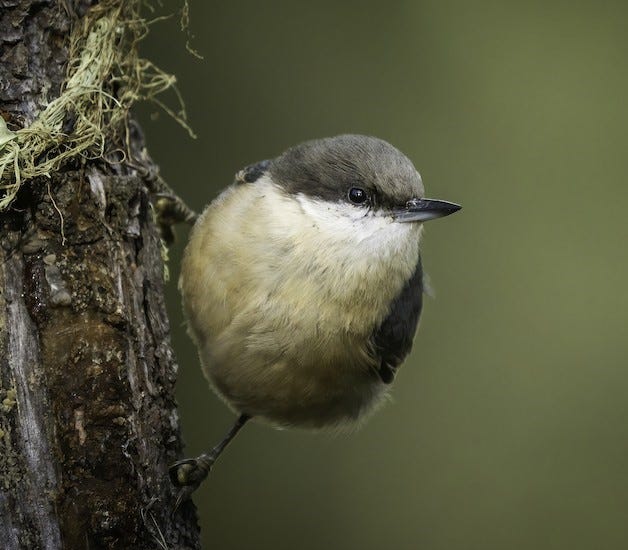
I am smiling before my binoculars even reach my eyes. No matter how often Pygmy Nuthatches visit my bird bath, I feel a caffeine-like mood-lift every time I lock onto those sprightly feathered orbs, with their blue-gray backs, brownish heads, and vanilla-cream fronts. I’ve counted as many as six drinking, bathing, or perching along a stick that leans against the bath to make it easier for woodpeckers and chipmunks to hitch up to the rim for a drink. Though open ponderosa pine forests in the mountain West are their preferred habitat, the little birds are sporadic visitors to the scattered ponderosas in my neighborhood. But when I hike in nearby forests, I am often accompanied by their high-pitched, piping calls as the tiny troubadours move through the treetops like miniature wind-up toys, thrusting their bills into bark crevices and pine needle clusters to extract insects.
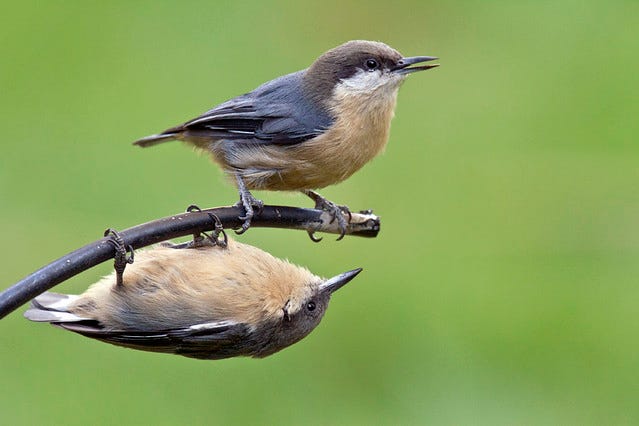
About the weight of four pennies, the diminutive Pygmy Nuthatch rarely seems to stop moving. Heading up and down tree trunks, moving along branches, feeding right-side up or upside down, the nuthatches are a whirlwind of activity and sociability. During the nonbreeding season family groups feed and travel together, often joining other species while foraging. Unlike most songbirds, Pygmy Nuthatches breed cooperatively. About a third of breeding pairs have male helpers—typically young from previous broods—that feed the incubating female, nestlings, and fledglings, and help defend the nest site.
At night, helpers and parents share the nest cavity (usually in a dead or partially dead pine tree) with the nestlings, all roosting together. Communal roosting also helps Pygmy Nuthatches survive cold winter temperatures. Unlike chickadees, which typically roost solo, Pygmy Nuthatches never roost alone. As many as 100 pygmies have been seen piling into a single roost hole (with 150 seen roosting in a single tree). The birds also survive cold nights by reducing their body metabolism and temperature to conserve energy.
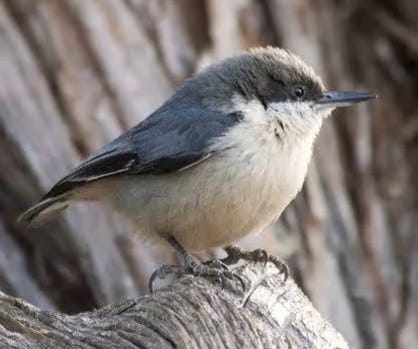
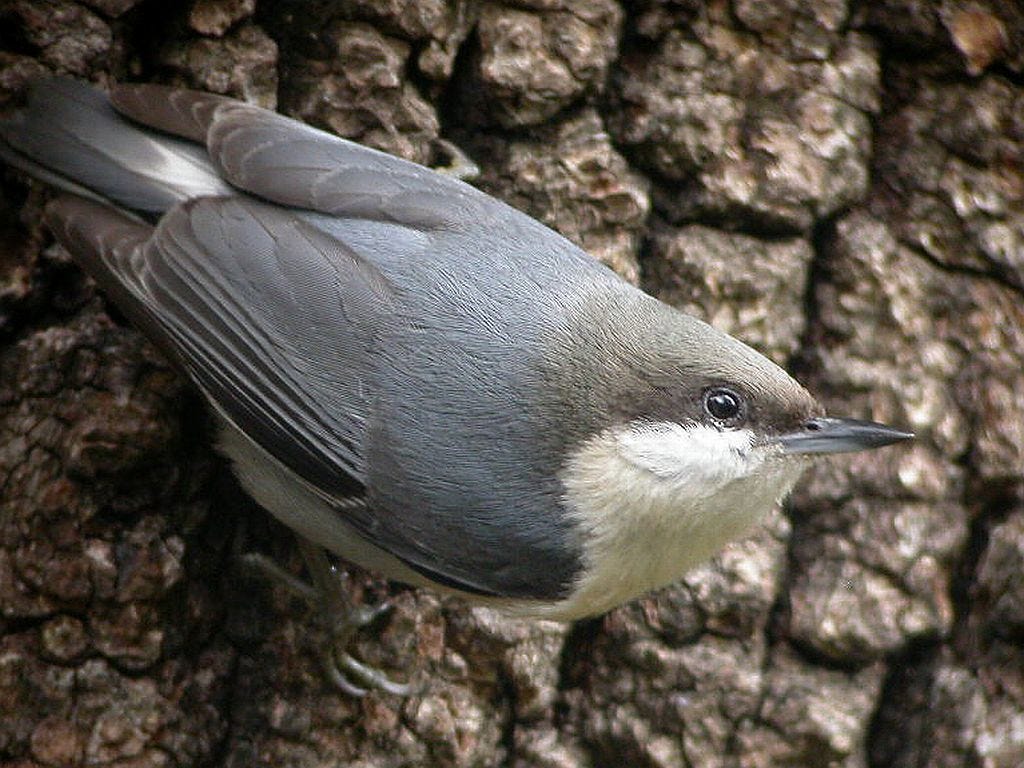
Closely related to the look-alike Brown-headed Nuthatch of the southeastern US, the Pygmy Nuthatch is an indicator of healthy ponderosa pine forests, which have been diminished by logging, grazing, and fire suppression throughout the West. Because they depend either on existing cavities or on the availability of soft, decaying wood in which to excavate their own nest sites, Pygmy Nuthatches thrive in older, less disturbed forests.
The scarcity of available cavities in younger, fragmented forests might explain the most unusual Pygmy Nuthatch nest I’ve ever found. Decades ago, while first exploring the patch of land that would one day become my current home, I spotted several pygmies amidst scattered ponderosas bordering open grassland. Several of the birds were going in and out of a hole—scarcely two feet off the ground—in a precarious-looking snag. Used to seeing the industrious birds up in the canopy, I watched in wonder as the nuthatches brought food to nestlings in a cavity that seemed acutely vulnerable to predators.
I’ve seen no nests on my property in recent years, and new houses have sprung up around me like mushrooms after rain. But I’m planning for the future by planting ponderosa pines near my house and nurturing several young saplings that I recently found in my field. I hope to always provide an oasis for the hyperactive Pygmy Nuthatch. And I celebrate the like-minded people who strive to help their local birds, too. In a world that’s seemed a bit bleak to nature lovers of late, there is something uplifting in knowing that being in it with their fellows—their tribe—is the superpower that allows Pygmy Nuthatches to survive tough times. A little solidarity can go a long way. Then again, the elfin nuthatches may just boost our spirits by providing us with a heartening dose of adorable whenever they cross our paths.
Take a small step to help birds
Birds are in crisis and need our help more than ever. According to the US Fish and Wildlife Service, over 96 million people in North America watch birds. If each of us does something (anything!) to help them, we may be able to reverse declining bird numbers.
It’s migration season, which means you can help birds by turning off non-essential lights. Our bright night lights are disorienting to migrating birds and often draw them off course, where they can encounter hazards like glass windows. Birds usually begin migrating 30 to 45 minutes after sunset, but numbers typically peak two to three hours later. Turning off night lights (or using downcast, motion-sensor lights) also helps birds indirectly by helping insects, which are an essential avian food source. Night lights attract and kill insects when the hapless creatures exhaust themselves in pointless circling around the light source.
Plant some native shrubs or flowers this spring. Most native insects did not evolve to feed on introduced, non-native plants, so our exotic gardens have far fewer insects available to feed birds during the critical nesting season. Native insects provide a host of other useful ecosystem services, too, such as pollination, decomposition, nutrient cycling, and pest control.
Plastics are a danger to birds the world over. Buy and use reusable grocery bags to reduce plastic waste. If you haven’t checked out reusable bags lately, note that you can purchase anything from sturdy, insulated, box-shaped bags with reinforced bottoms to collapsible bags that fold into small pouches.
Until next time …
Huge thanks to those who support my writing and bird-conservation work by buying me coffee!
Thank you so much for making time to read it, Joe!
Oh, Sophie, you have done it again! Even before reading your vibrant, cinematic descriptions of these tiny sprites, the photos had me melting and grinning simultaneously! The grin remains as I write this. You are a spectacular artist with words! Please don't ever stop writing! And three cheers (well, make it four, one for each penny's worth of weight) for the Pygmy Nuthatches that grace our world and make it a cheerier place!!!