

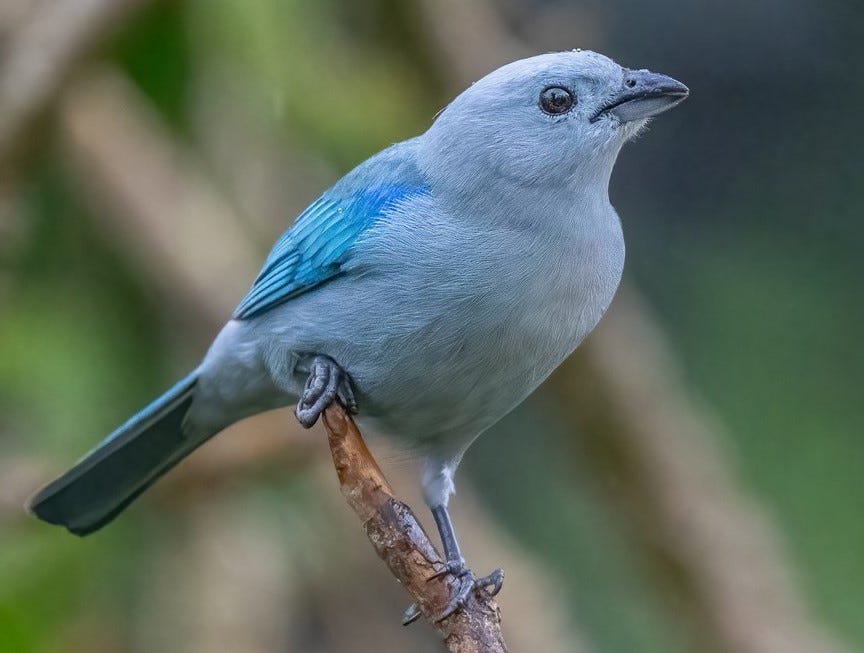
A touch of blue amidst the gray
November can be a challenging month for northerners who thrive on color and sunlight. Leaden skies bear down on our homes. Landscapes animated by shades of green have faded to somber palettes of yellow-browns and grays. Night comes quickly and stays longer. And many of the birds whose activities enlivened our spring and summer days have moved on to their wintering haunts.
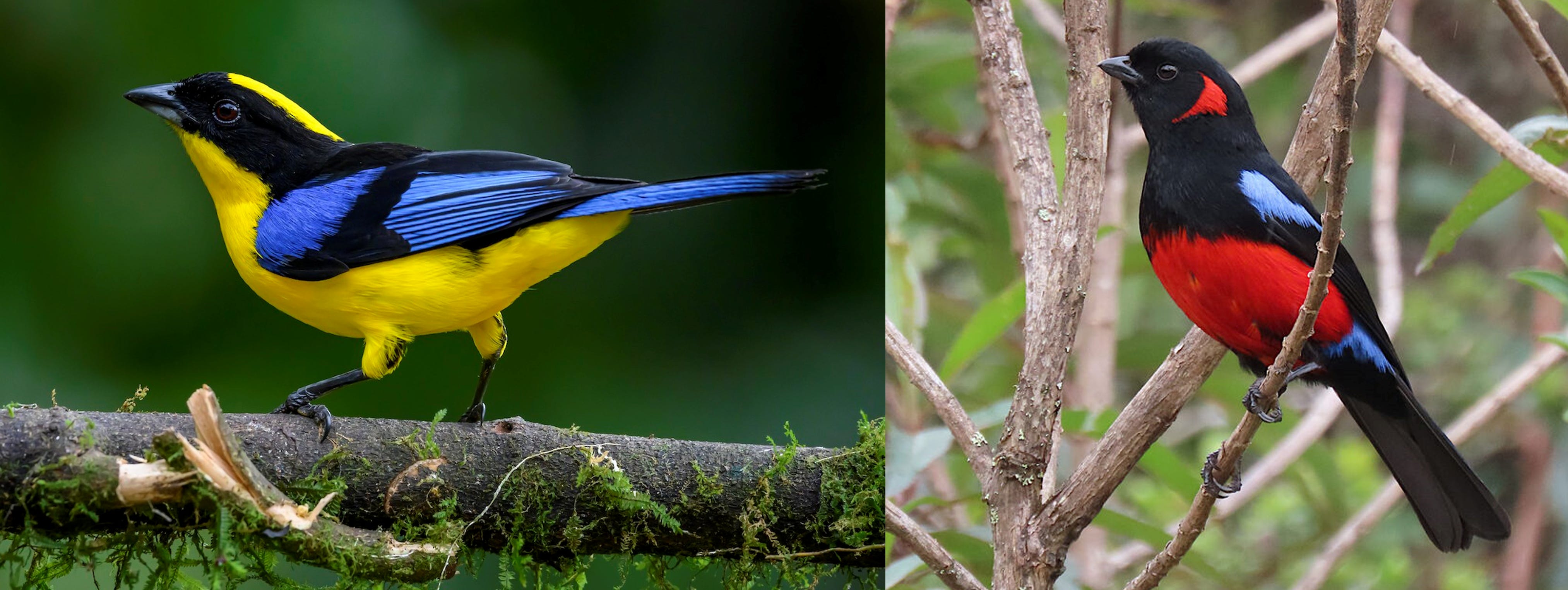
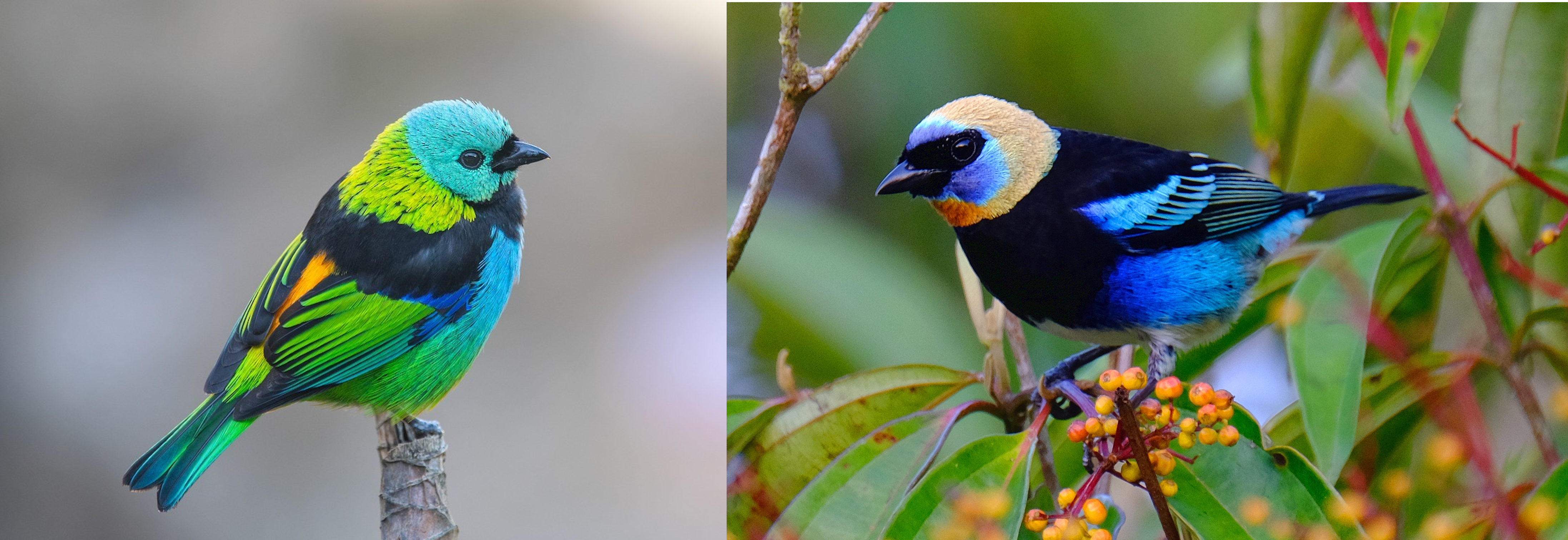
So it is not without a touch of envy that I am picturing the activities of these migratory birds in the warmth, color, and vibrancy of their nonbreeding grounds. Doing so turns out to be the perfect antidote to my depressed spirits because my mind is immediately filled with images of places and creatures I have known in these tropical haunts. Among the first that springs to mind is the beautiful Blue-gray Tanager. A common bird of the tropics, the Blue-gray is a member of the Thraupidae (tanager) family—the second largest family of birds in the world, with nearly 400 species. (Surprisingly, these no longer include the northern-breeding Scarlet and Western Tanagers—despite their names—since taxonomists moved them to the cardinal family based on genetic evidence in 2009.)
Subtly lovely in its muted gray and cerulean plumage, the Blue-gray Tanager inhabits a wide variety of open and semi-open habitats from southeastern Mexico to central South America, including much of the Amazon basin. Found in young forests and forest borders, in savannas with scattered trees, along rivers and lakes, and even in urban parks and gardens, the tanager feeds on fruits, insects, and nectar. It is sometimes seen perching on utility lines and will use crevices in buildings as nest or roost sites. Given that the Blue-gray thrives in habitats that have been altered by people, it’s perhaps not surprising that it is among the most familiar birds in settled areas within its range. And maybe this is why seeing a Blue-gray Tanager has always made me smile. Often one of the first birds I sighted upon arriving in tropical America, it seemed to be the greeter that welcomed me to these foreign lands.
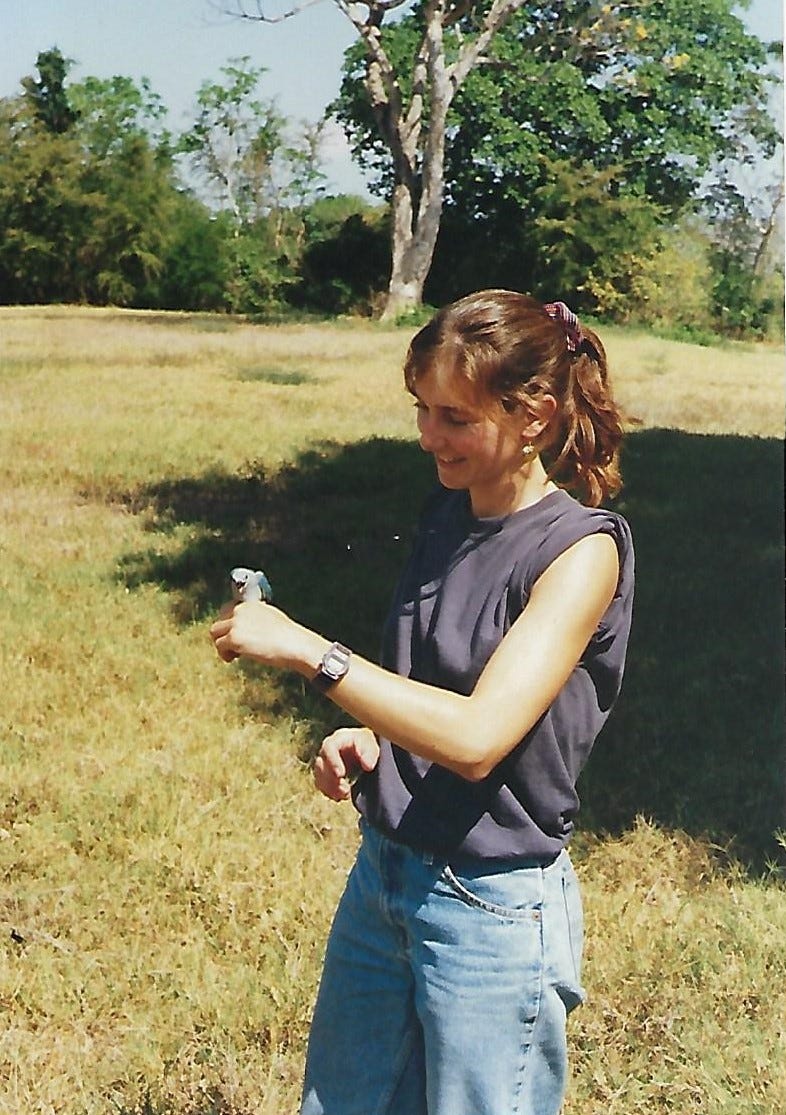
I encountered my first Blue-gray Tanager decades ago when I traveled to Central America for the first time to study and help conserve a threatened parrot in southern Guatemala. In addition to seeing the tanager perched alongside streams and fields on the working ranch where I was based, I was treated to close-up views of the bluebird-like bird after capturing one with colleagues who were studying the area’s avian diversity. (Captured birds were examined, outfitted with identifying leg bands, then released unharmed.) As I held this elegant tanager in my hands, I felt like I’d captured a piece of the sky.
In the decades that followed, I saw Blue-gray Tanagers at the outset of my travels in Costa Rica, Honduras, Panama, Colombia, Ecuador, and Peru. Each time, these tanagers were the feathered gateways that welcomed me to the tropics and hinted at the exotic birds I was sure to see as I embarked on new work or birding adventures.
For many people, birds disappear into the black hole of the unknown when they leave their breeding grounds in the fall. But scientific research, the relative ease of global travel, and the activities of millions of birders, who record their sightings on the online birding platform known as eBird, are increasingly illuminating parts of birds’ lives that were once hidden from us. Now, when we spot certain warblers, flycatchers, or swallows in our northern backyards or parks, we can safely surmise that they are as familiar with birds like the Blue-gray Tanager as they are with our local Black-capped Chickadees.
So if you have the good fortune to travel to tropical America this winter, look out for that beloved avian ambassador, the Blue-gray Tanager. And if, instead, you are home, taking refuge from some gloomy winter weather, perhaps the thought of your summer birds sharing a tree with a tropical tanager will add a touch of sky-blue to your gray day.
Take a small step to help birds
Birds are in crisis and need our help more than ever. According to the US Fish and Wildlife Service, over 96 million people in North America watch birds. If each of us does something (anything!) to help them, we may be able to reverse declining bird numbers.
Check out the Cornell Laboratory of Ornithology’s Panama bird cam to see if you can spot a Blue-gray Tanager visiting a fruit table. Aside from seeing some delightful tropical birds, connecting with another component of “our” migratory birds’ lives inspires efforts to conserve the breeding, nonbreeding, and migratory habitats that support the world’s birdlife.
In this giving season, consider donating to an organization that helps our birds. The American Bird Conservancy works to conserve birds in the western hemisphere, including protecting habitat for a variety of tropical tanagers—and the northern birds that join them in the nonbreeding season. The Cornell Lab of Ornithology (developer of the incredibly popular bird identification app Merlin) makes outsized contributions to bird research and conservation.
By recording your bird sightings in eBird (available as a phone app), you contribute to a growing information database that scientists can use to study bird habits and haunts the world over. Aside from transforming your bird sightings into science and conservation, you can also use eBird to find birds you’re hoping to see, plan trips, keep track of your bird sightings, and discover which birds are being seen with your favorite migratory birds when they’re in their nonbreeding grounds.
Until next time …
P.S. Please consider giving a copy of my book Feather Trails—A Journey of Discovery Among Endangered Birds to the animal lovers on your holiday gift list. If you purchase the book from Chelsea Green Publishing, you can get 35% off by using the code CGP35 at checkout.
If you’d like to help fuel my words for birds, I’d gratefully accept a cup of coffee : )
Thanks for that bright spot in today's cloudy, cold gloom! It's often hard to remember so much color graces this world on dull grey days like today! Enjoy your coffee ☕😉
Maybe my favorite thing about each new month is receiving your missive on that day. Lovely as always, Sophie! Happy Holidays!