
Tropical enchantment

What’s in a name?
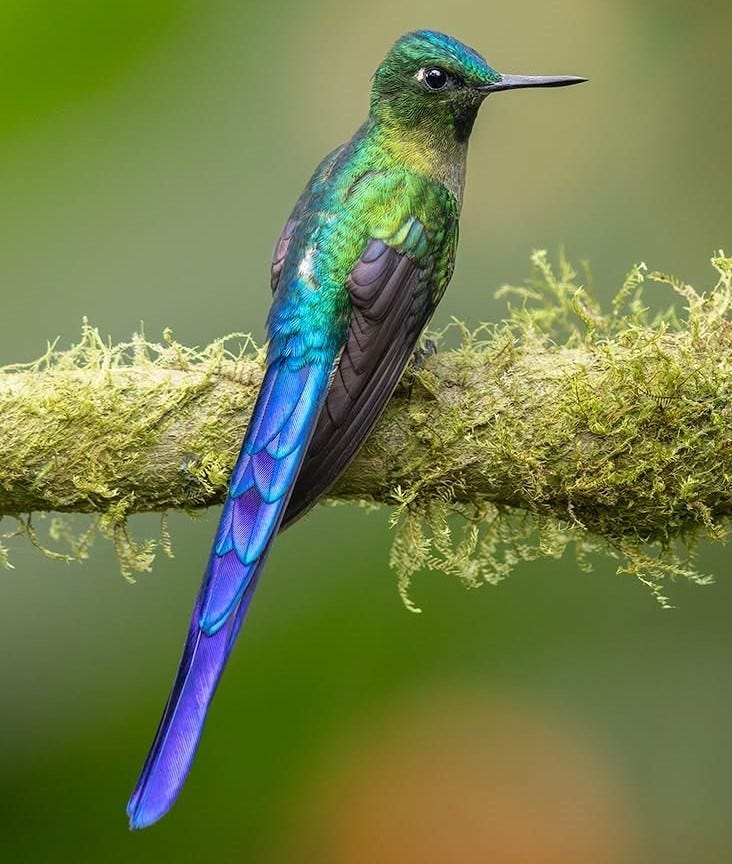
Fairy. Sylph. Woodstar. Sunangel. The names might be found in a children’s story about an enchanted forest, where fairies glide down moonbeams and woodland animals gather in harmony. Instead, they are the products of the whimsy, wonder, and vivid imaginations of long-ago ornithologists who were captivated by sparkling tropical hummingbirds and bestowed them with these fanciful names.
Seeing new birds in new places is one of the greatest joys for bird watchers of all stripes. But word-loving birders are in for an additional treat if they have an opportunity to enjoy some of tropical America’s scintillating hummingbirds. When I spotted my first Purple-crowned Fairy in Costa Rica and my first Violet-tailed Sylph in Ecuador, the birds lit up my world with their diminutive dazzle, but their names imbued the moments I spent observing them with a touch of magic.
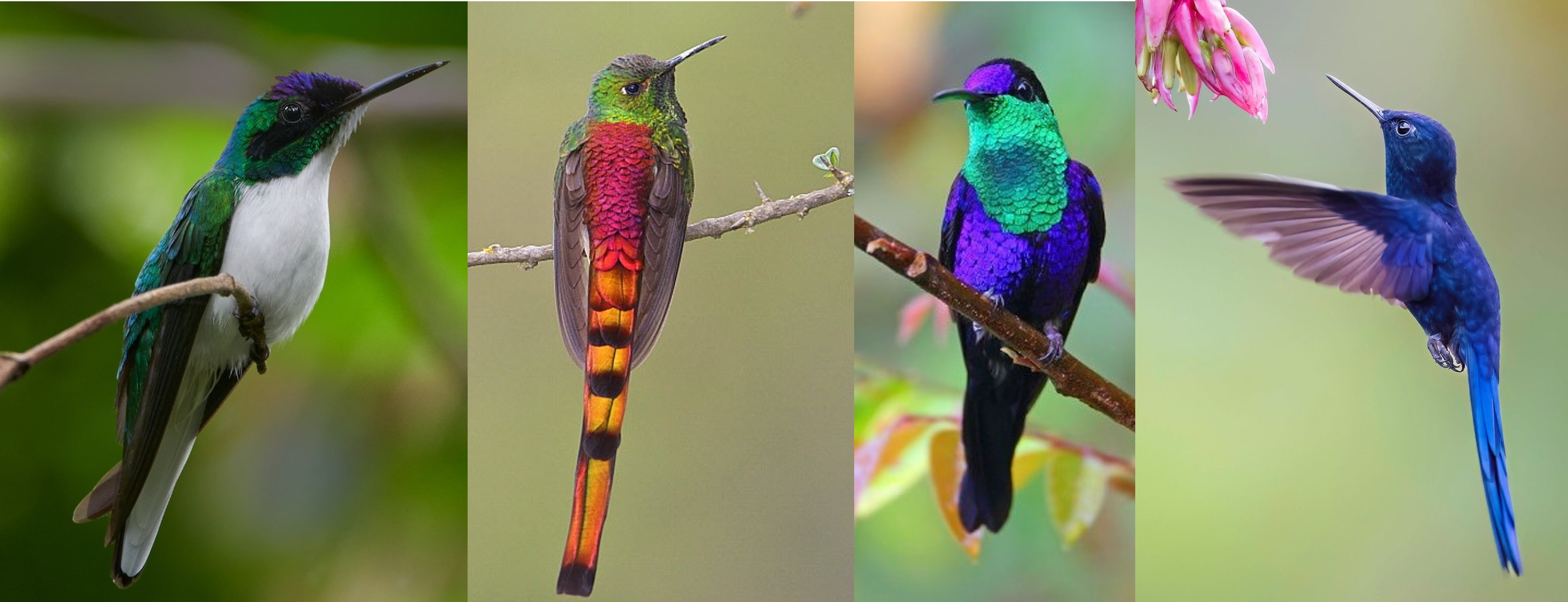
Found exclusively in the western hemisphere, the world’s 360 or so hummingbird species reach their greatest diversity in Central and South America. (Their counterparts in Africa and Asia are the somewhat similar looking but unrelated Sunbirds.) Only one hummingbird, the much-loved Ruby-throated breeds in the eastern US, and three species (Rufous, Black-chinned, and Calliope) can be seen in my Montana neighborhood. But Colombia alone hosts over 160 species, while smaller Ecuador has about 130.
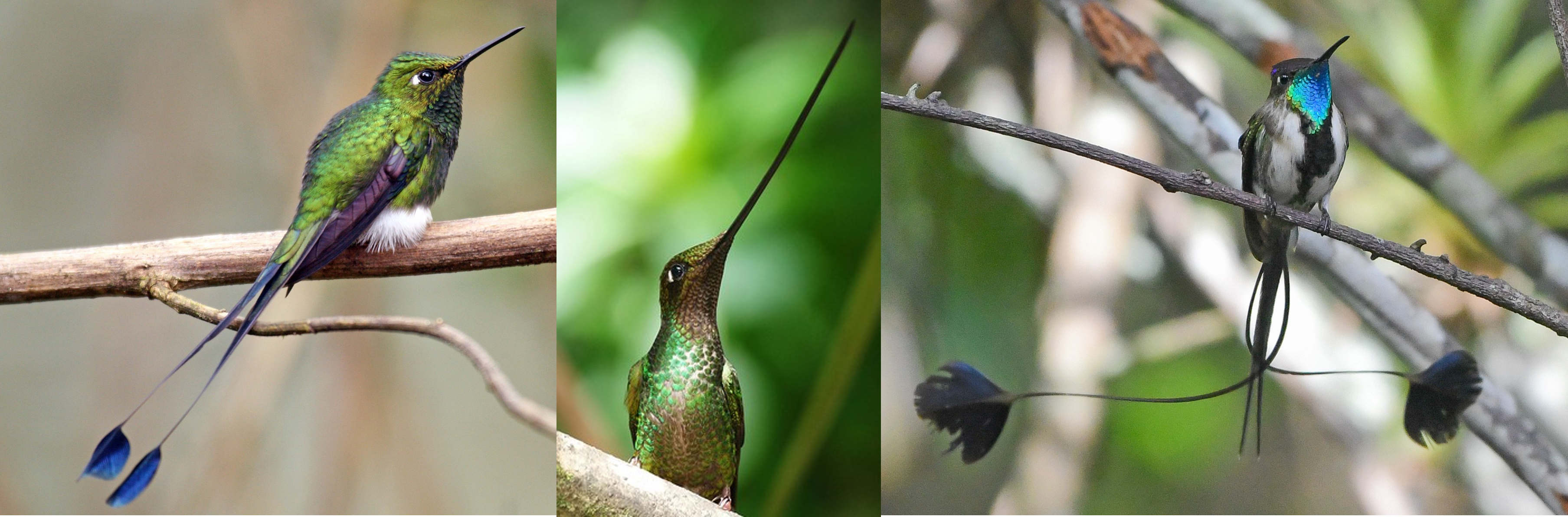
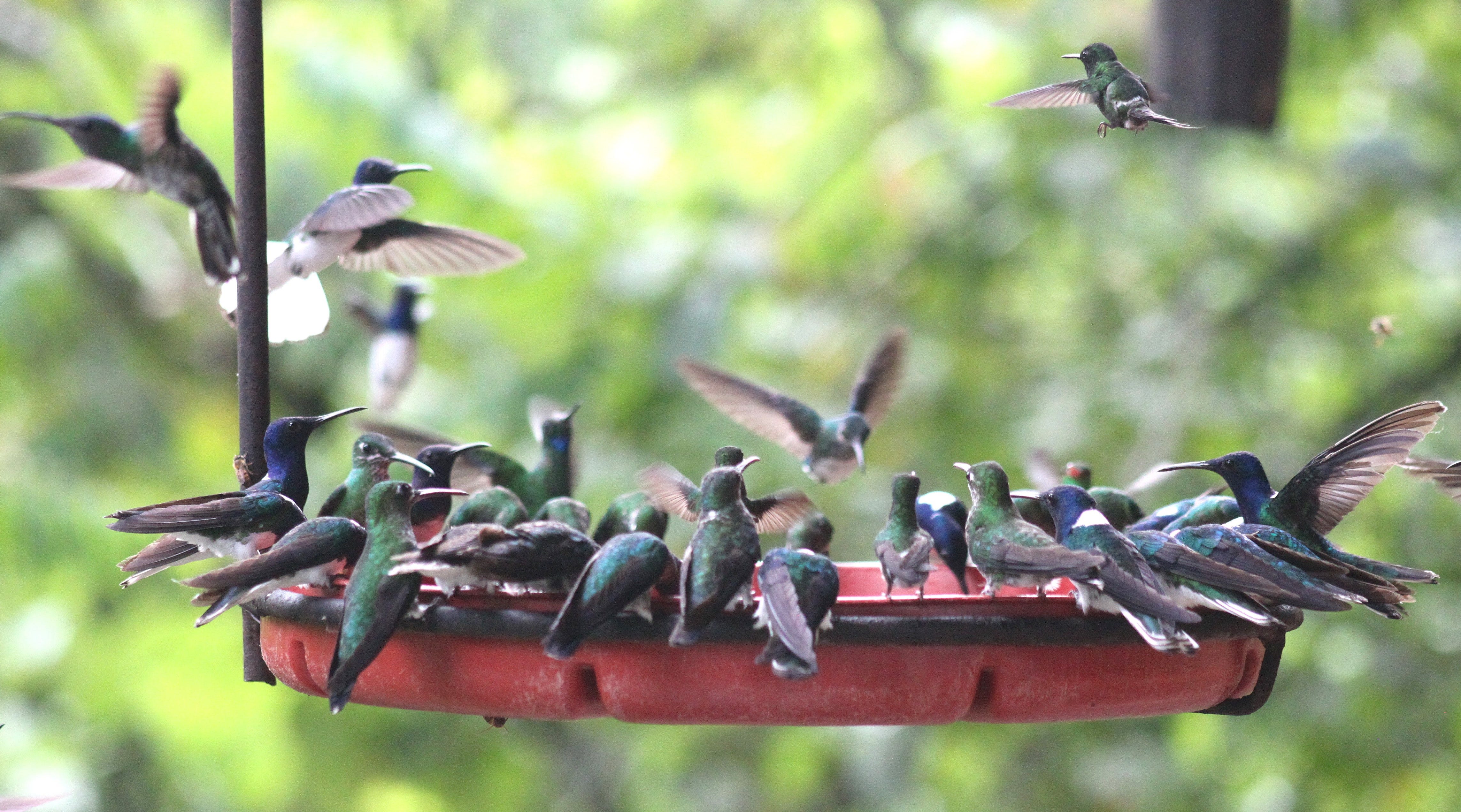
Visitors to tropical America can’t help but be captivated by the glittering colors and astonishingly varied forms of these pugnacious, nectar-loving sprites. Watching a hummingbird feeder in the tropics can mean trying to identify as many as 10 species at once and being surrounded by dozens of whirring bodies. Tiny male White-booted Racquet-tails—sporting puffy white leg tufts and long, wire-like tail feathers ending in paddle-shaped “racquets”—enchanted me in Peru’s misty cloud forest. The White-tailed Starfrontlet commanded my attention in Colombia. And the legendary Sword-billed Hummingbird wowed me in Ecuador.
During years of tropical field work and travel, I became familiar with woodstars and woodnymphs, sunangels and sunbeams, coronets and coquettes, brilliants and blossomcrowns, sapphires and emeralds—each imaginatively named group of hummingbirds consisting of related species.
Different hummingbirds inhabit diverse regions and microhabitats, often exhibiting unique feeding strategies or targeting specific flowers. Some, like the forest-understory-loving hermits, display on communal breeding grounds known as leks to attract females. Other hummingbirds dip and dive singly to claim a territory and attract a mate. Many aggressively defend their nectar sources while others mimic flying bees and sneak meals from occupied territories. Still others fly long distance “traplines,” targeting flowers along their routes that have enough nectar to make the hummingbirds’ journeys worthwhile.
Sadly, these glittering tropical gems with the fanciful names too often confront humanity’s hard edges: its rampant habitat destruction and free-roaming cats, its roads and powerlines, its glass windows and insect-killing poisons. But such pressures can be lessened when we become aware of what we stand to lose with every tropical acre that’s destroyed.
Preserving biodiversity is critical to the health of the planet, but there is still room for wonder and whimsy in the world, too. We go to great lengths to ensure that children have enchantment in their lives—the Tooth Fairy and the Easter Bunny, Santa and his reindeer. So perhaps it’s not too much to hope that enough bird lovers will support the fairies, the sylphs, and their sparkling counterparts to ensure that there is always a little magic out there for adults, too.
Take a small step to help birds
Birds are in crisis and need our help more than ever. According to the US Fish and Wildlife Service, over 96 million people in North America watch birds. If each of us does something (anything!) to help them, we may be able to reverse declining bird numbers.
I once received a phone call from someone asking for help with a hummingbird whose wing had been broken by her cat, which liked to lurk in her pollinator garden. (There was nothing I could do besides recommend euthanasia.) “Every year my cat captures a few hummingbirds but they usually fly off,” she said, not realizing that any bird that a cat merely scratches or bites will usually die. Cats carry a bacterium (Pasteurella multocida) in their mouths (and on their claws since they lick them regularly) that is lethal to birds and can kill them within 48 hours. The infection progresses so fast that birds often die suddenly without showing signs of illness. Keeping our domestic cats indoors protects vulnerable hummingbirds (and other birds) from these lethal, non-native predators.
If you feed hummingbirds, avoid using nectar/sugar mixes that contain red dyes or artificial ingredients. A red feeder is sufficient to attract the birds. It’s easy to make your own sugar mix: Boil four cups of water, add in one cup of white sugar, stir, and let cool. For smaller batches, maintain the 4 (water) to 1 (sugar) ratio.
Add a splash of color to your day by watching exotic tropical birds and hummingbirds via the Cornell Lab of Ornithology’s Panama fruit feeder birdcam. Scroll down their webpage to see all the possible hummingbirds (and other spectacular birds) that you might spot.
Support US-based conservation organizations, such as the American Bird Conservancy and Rainforest Trust, which protect tropical bird habitat, and/or support great Latin American conservation organizations such as Fundación Jocotoco in Ecuador, Asociación Ecosistemas Andinos (ECOAN) in Peru, and SELVA in Colombia.
Until next time …
P.S. If you want to know what it’s like to be a field biologist working in wild places with birds and other animals, check out my book Feather Trails: A Journey of Discovery Among Endangered Birds (get 35% off with code CGP35) or pre-order my forthcoming book Wild Work: Adventures of Women Field Biologists (publication date: Sept 1, 2026).
Huge thanks to those who have supported my writing and bird-conservation work by buying me coffee! Special thanks to those who are supporting me monthly!
Such beauty in a small package!
Great article, Sophie! Such clean, crisp, precise, and inspired writing!