
Happy New Year!

Happy New Year Words for Birds readers! For the first time in a very long time, I took a little time off over the holidays. So, rather than regale you with my usual fare, I’m instead posting a recent article that I wrote for the American Bird Conservancy’s Bird Conservation magazine (2025 fall issue)—with apologies to those who have already seen it. I wish you all the very best in the coming year. Let’s do what we can to make it a good one for the world’s beleaguered birds, too. I’ll be back with more words and tips for helping birds in February.
The Hidden Lives that Connect Us
“Oh, that’s one of our birds,” I exclaimed as my binoculars revealed the jaunty black cap and exuberant yellow of a tiny Wilson’s Warbler. I was in Guatemala to research parrots, and my colleague, Marco, was introducing me to the project area and a panoply of tropical birds.
“Your birds?” Marco teased. “That’s one of our birds. We loan them to you for a few months each year, and you send them back to us exhausted, emaciated, and in their worn plumage. We care for them, feed them, dress them in their finest colors, and then send them back to you again.”
Laughing, I conceded his point. Many birds molt into drabber plumages before their southward migration and burn accumulated fat on their long journeys. But Marco’s words, which underscored the connection migratory birds forge between people living in their breeding grounds and those who welcome their return during other seasons, forever lessened my northern bias.
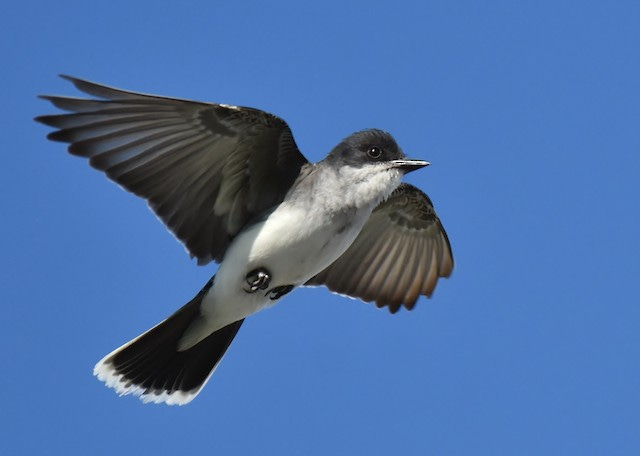
Decades later, his words still resonate as I relish the kingbird moments that animate my morning runs. Journeying all the way from western Amazonia, Eastern Kingbirds are among the last arrivals to my rural Montana neighborhood in the spring.
Few who see an Eastern Kingbird perched next to a field in its northern haunts picture this relatively common bird in its “home away from home” by a river in a tropical forest that rings with the insistent hum of cicadas, as monkeys move through the treetops and parrots and toucans feed nearby. Through their travels, migratory birds such as kingbirds connect their disparate breeding and nonbreeding grounds, and every spot where they rest and refuel in between.
As I run by my first kingbird of the year, perched by a clear-running stream bordered by willows, I celebrate crossing winter’s finish line into spring. In the coming days, a pair of kingbirds graces my mornings, their chatter sounding like electrical sparks. When spring’s exuberance mellows into summer, I spot the male perched in solitary vigil while his mate incubates their eggs nearby. And finally, weeks later, I delight in seeing a kingbird family by the stream, the adults voicing frenzied warnings to their naïve offspring as I run past. By early August they are gone and the unwelcome quiet of the coming season settles around me as I wonder where the birds that brightened my summer might now be.
Once birds leave our local patches, their fates are usually unknown to us. But research is illuminating these hidden lives—where birds go seasonally and how they get there. Birders, too, are strengthening our connections to distant lands—and those who live in them—by recording their sightings throughout the hemisphere on eBird checklists available to everyone.
Working to recover critically endangered birds during my career affirmed for me that the individuals that make up our bird populations matter. And at this break-glass moment, when 3 billion birds have disappeared over the last 50 years, what each of us does to support the individual birds that touch our lives matters more than ever.
Reminding us of our shared humanity, birds stitch together a world devoid of boundaries and divisions. It’s a daunting task to spur widespread individual and collective conservation actions in these uncertain times. But therein lies the power of birds: to inspire us to aspire to a better, more sustainable world for all.
Until next time …
P.S To read more about my work in tropical America, please check out my book Feather Trails—A Journey of Discovery Among Endangered Birds. If you buy it direct from Chelsea Green Publishing, you can get a 35% discount when you use the code CGP35 at checkout.
If you’d like to support my writing and bird conservation work in 2026, you can always:
Yay for a teeny bit of time off (sort of, but not really off, as I know you were working)! Wishing the birds a successful 2026!
Nice article, Sophie! I love eastern kingbirds. I loved how you painted the picture of their surroundings in the Amazon, with the monkeys and toucans. :-) Sounds pretty nice.